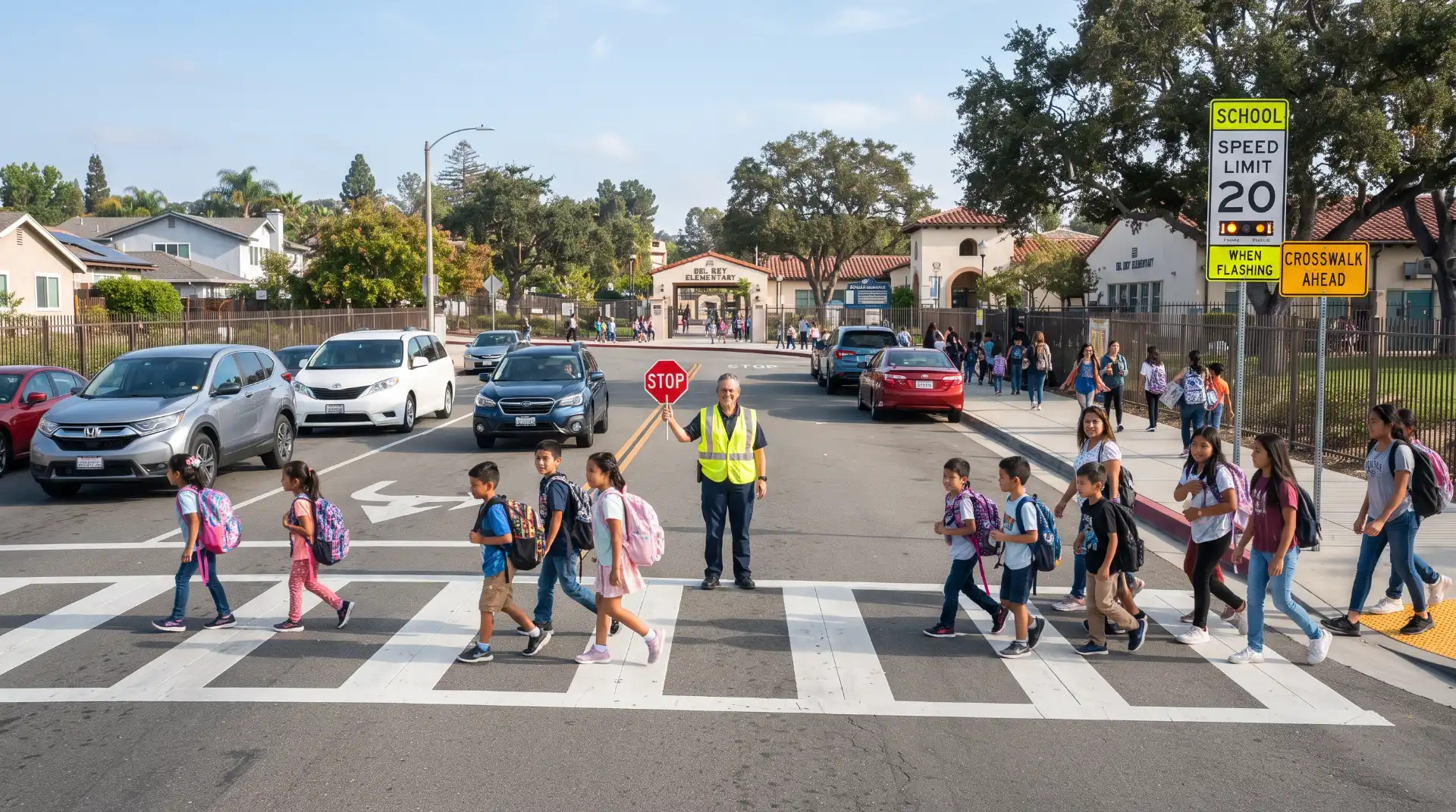
School zones are among the places where California drivers are expected to exercise the greatest caution. Children may enter crosswalks unexpectedly, parents may be dropping students off along crowded curbs, school buses can block sightlines, and traffic patterns can change dramatically within a matter of minutes. Even a relatively small difference in vehicle speed can affect how much time a driver has to recognize a pedestrian and stop.
California has responded to these risks with a significant change to its school-zone speed laws. Assembly Bill 382, signed in 2025 and effective January 1, 2026, created a pathway for local authorities to establish a 20 mph prima facie speed limit in qualifying school zones. The legislation also establishes a broader statewide 20 mph school-zone framework that becomes operative on January 1, 2031.
That distinction is important. Contrary to some descriptions of the new law, California did not automatically change every school zone from 25 mph to 20 mph on January 1, 2026. During the transition period, drivers must pay close attention to posted signs because the applicable limit can vary depending on the location and the action taken by the local jurisdiction.
The new rules are especially important when a pedestrian accident occurs near a school. A posted 20 mph limit can become significant evidence when determining whether a driver was traveling too fast, whether the driver exercised reasonable care, and whether excessive speed contributed to an injury.
What Is California’s New 20 MPH School Zone Law?
Assembly Bill 382 amended California’s school-zone speed framework. Beginning January 1, 2026, California Vehicle Code Section 22352.5 allows a local authority, through an ordinance or resolution, to establish a prima facie speed limit of 20 mph in a school zone.
For purposes of the legislation, a school zone generally covers an area of highway within 500 feet of school grounds unless otherwise posted. Appropriate signs must give drivers notice of the applicable limit.
The change gives cities and other local authorities greater ability to lower speeds around schools before the statewide provision takes effect. As a result, motorists may increasingly encounter 20 mph school zones throughout California during the next several years.
For the moment, however, the familiar 25 mph rule has not disappeared statewide. The California DMV continues to instruct motorists that the speed limit is generally 25 mph within 500 feet of a school when children are outside or crossing the street, unless another properly established limit applies. Some school areas can also have even lower limits under California law.
Drivers should therefore rely on the signs at the particular school rather than assuming that every school zone has the same limit.
When Does the Statewide 20 MPH Rule Begin?
The statewide change is scheduled to become operative on January 1, 2031. At that point, California Vehicle Code Section 22352 will establish a prima facie 20 mph limit in a school zone when specified conditions apply.
Those conditions can include situations in which school-zone signs indicate that the reduced limit applies when children are present or during designated periods. The statute also defines what qualifies as a school zone and when children are considered present for purposes of the rule.
Until then, the transition period allows local governments to adopt 20 mph school-zone limits under the authority created by AB 382.
This phased approach matters to pedestrian accident claims. A collision occurring in 2026, for example, should be evaluated according to the speed limit legally established and posted at that particular location rather than assuming that the future statewide rule already applies.
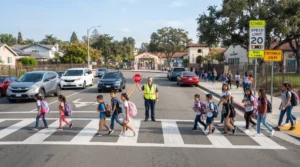
Why Vehicle Speed Matters So Much Around Schools
Speed affects much more than the number displayed on a speedometer. It influences how far a vehicle travels before the driver reacts, how much distance is required to stop, and how severe an impact may be if a collision occurs.
School zones present additional challenges because young pedestrians do not always behave like adults. A child may misjudge the speed of an approaching vehicle, suddenly follow another student into a crosswalk, become distracted by friends, or be difficult for a driver to see behind parked SUVs and school buses.
A driver traveling too quickly has less opportunity to respond to those hazards.
Even when a driver is technically below the maximum posted limit, California motorists are still expected to drive at a speed that is reasonable for actual conditions. Congested pickup lanes, heavy pedestrian activity, reduced visibility, weather, construction, or unusual traffic can require a prudent motorist to travel more slowly.
The existence of a 20 mph school-zone limit reinforces the broader principle that roads surrounding schools require heightened attention.
How a 20 MPH Limit Can Affect Pedestrian Accident Liability
Pedestrian accident liability generally depends on negligence. In simplified terms, a claimant typically examines whether another person failed to use reasonable care and whether that failure contributed to the injury.
If a driver strikes a student or another pedestrian while exceeding a properly posted 20 mph school-zone limit, the speeding violation can become important evidence of negligent conduct.
Investigators and attorneys may examine the posted speed limit, vehicle speed, braking distance, visibility, traffic conditions, crosswalk configuration, witness statements, surveillance footage, vehicle data, and the driver’s actions immediately before the collision.
A speeding citation can be relevant, but civil liability does not necessarily depend on whether police issued a ticket. A driver may still be found negligent based on the available evidence even when no traffic citation was written.
Speeding Is Not the Only Form of Driver Negligence
A pedestrian accident near a school can involve several forms of negligence at the same time. Speed is only one factor.
A motorist may be traveling at 20 mph but still fail to yield to a child already using a crosswalk. Another driver may be looking at a mobile phone while approaching a school entrance. Someone backing out of a parking space may fail to notice a student walking behind the vehicle. A driver making a turn may focus on oncoming cars while overlooking a pedestrian entering from the opposite side.
School-zone crashes can also involve drivers passing stopped vehicles, ignoring crossing guards, making unsafe turns, driving impaired, or proceeding around buses without appropriate caution.
California’s rules regarding pedestrian rights and driver responsibilities are discussed further in our guide to California pedestrian laws.
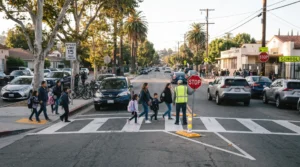
Pedestrian Right-of-Way in California Crosswalks
California Vehicle Code Section 21950 generally requires drivers to yield the right-of-way to pedestrians crossing within marked crosswalks and within unmarked crosswalks at intersections.
The law also requires drivers approaching pedestrians in crosswalks to exercise due care and reduce speed or take other appropriate action when necessary to protect pedestrian safety.
This duty can become particularly important around schools because drivers have reason to anticipate children walking near intersections and designated crossings.
However, pedestrians also have responsibilities. California law does not permit a pedestrian to suddenly leave a curb or other place of safety and enter the path of a vehicle that is so close as to create an immediate hazard.
These competing duties mean that pedestrian accident cases require careful investigation instead of relying solely on the assumption that one party always has complete responsibility.
What If a Child Runs Into the Street?
One of the most difficult school-zone accident scenarios occurs when a child unexpectedly enters the roadway.
A driver may argue that there was no reasonable opportunity to avoid the collision. Whether that defense is persuasive depends heavily on the circumstances.
Investigators may consider whether the driver was already exceeding the speed limit, whether the driver was watching the roadway, whether parked cars created an obvious visibility hazard, and whether a reasonable motorist approaching a school should have anticipated children nearby.
The driver’s reaction time and braking behavior may also become important. Modern vehicles can contain event data that helps reconstruct speed, braking, throttle position, and other actions immediately before a crash.
The fact that a pedestrian entered the roadway suddenly therefore does not automatically resolve liability in the driver’s favor.
California’s Comparative Negligence Rule
California follows a pure comparative negligence system. This means responsibility for an accident can be divided among multiple parties according to their respective contributions to the collision.
Suppose, for example, that evidence shows a pedestrian acted carelessly when entering the roadway but also shows that the driver was exceeding a posted school-zone limit and could have avoided the impact at a lawful speed. A jury could assign a percentage of fault to both parties.
The pedestrian’s recoverable damages would generally be reduced according to the percentage of responsibility attributed to that pedestrian.
This rule is especially relevant outside marked crosswalks. California’s recent changes to jaywalking enforcement do not eliminate the ordinary rules governing civil negligence. Our detailed guide to jaywalking and pedestrian accident liability in California explains the distinction between traffic enforcement and civil fault in greater depth.
Could a School District or Government Entity Be Liable?
Not every school-zone pedestrian accident is solely a dispute between the pedestrian and the driver. Roadway design or dangerous public property conditions can sometimes become relevant.
Examples can include an allegedly dangerous intersection configuration, obstructed visibility, malfunctioning traffic signals, missing signs, or another condition of public property claimed to have contributed to the collision.
Claims against public entities involve legal requirements that differ substantially from ordinary personal injury claims. California’s Government Claims Act generally requires certain claims against public entities to be presented within a much shorter period than the ordinary personal injury statute of limitations.
Whether a city, school district, state agency, or another public entity can actually be held responsible depends on the specific facts and applicable governmental liability statutes. The mere occurrence of a crash near public property does not establish government negligence.
Why School-Zone Signs Matter After an Accident
Photographs of traffic signs can become valuable evidence after a school-zone collision. Because California is transitioning between different school-zone rules, documentation of the exact sign in place on the accident date may help establish the applicable speed limit.
A photograph can show whether the limit was 20 mph, 25 mph, or another number, where the sign was located, and whether any accompanying language limited when the reduced speed applied.
The condition and visibility of the sign may also matter. Trees, construction equipment, parked trucks, vandalism, or damage can sometimes obstruct a sign.
Investigators may supplement photographs with municipal records showing when a speed limit was adopted and when signs were installed.
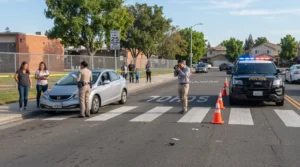
Evidence Used to Determine Vehicle Speed
Drivers involved in pedestrian crashes sometimes disagree about how fast the vehicle was traveling. Fortunately, speed can often be investigated through multiple types of evidence.
Police may examine tire marks, the final resting positions of the vehicle and pedestrian, roadway evidence, vehicle damage, surveillance recordings, dash cameras, and witness accounts. Nearby schools, homes, buses, businesses, and traffic systems may have cameras that captured the collision or the vehicle immediately beforehand.
Some modern vehicles also retain electronic information capable of helping qualified experts reconstruct events surrounding an impact.
Accident reconstruction specialists can use physical and digital evidence to evaluate whether the driver’s claimed speed is consistent with the collision.
For a broader explanation of this process, see our guide on how pedestrian accidents are investigated in California.
What Happens When a Driver Was Traveling 25 MPH in a Posted 20 MPH Zone?
A difference of five miles per hour may sound minor, but it can become legally significant when the applicable limit is 20 mph.
If a jurisdiction properly established and posted a 20 mph school-zone speed limit, traveling at 25 mph may constitute speeding when that limit is in effect. In a pedestrian injury case, the central question would then become whether the excess speed contributed to causing the collision or increasing its consequences.
For example, an accident reconstruction analysis might evaluate whether a vehicle traveling at 20 mph could have stopped before reaching the pedestrian while the same driver traveling at 25 mph could not.
Evidence that speeding reduced the available stopping distance can strengthen an argument that the violation was causally connected to the injury rather than merely incidental.
What If a Driver Was Below 20 MPH?
Driving below the posted limit does not automatically eliminate negligence.
California’s basic speed principles require motorists to adjust their driving to roadway conditions. A driver moving at 18 mph could still be negligent if that speed was unsafe in an extremely congested crosswalk area, or if the driver was distracted and failed to yield.
Likewise, lawful speed does not excuse running a stop sign, ignoring a traffic signal, failing to obey a crossing guard, or turning into a pedestrian who has the right-of-way.
Speed-limit compliance is therefore one part of a broader liability analysis.
The Role of Crossing Guards and School Traffic Controls
Crossing guards are positioned at many California schools to manage predictable periods of heavy pedestrian traffic. Drivers should remain alert for their signals and for children who may enter the road while a crossing guard is controlling traffic.
Other safety measures can include marked crosswalks, curb extensions, warning signs, flashing beacons, school-zone pavement markings, pedestrian signals, and loading zones.
A motorist cannot assume that ordinary traffic patterns will continue unchanged when entering an active school area. Morning arrival and afternoon dismissal can transform a normally quiet street into a dense mixture of vehicles, bicycles, pedestrians, buses, and parents.
What Families Should Do After a School-Zone Pedestrian Accident
The immediate priority after a serious pedestrian accident is medical care. Injuries involving children can include fractures, head trauma, internal injuries, spinal injuries, and other conditions that may not be fully apparent at the scene.
When circumstances permit, preserving evidence is also important. Photographs of the vehicle, road, crosswalk, signs, traffic controls, weather, and surrounding area can help establish what conditions existed at the time of the crash.
Witness information can be particularly useful because school arrival and dismissal periods may produce numerous observers. Nearby parents, staff, crossing guards, bus drivers, residents, and other motorists could have relevant information.
Video evidence should be identified quickly because some surveillance systems automatically overwrite recordings after a relatively short period.
Additional guidance is available in our article discussing steps to take after a pedestrian accident in California.
Insurance Coverage After a School-Zone Pedestrian Collision
When a negligent driver causes a pedestrian accident, the driver’s liability insurance is commonly one potential source of compensation. The available coverage and responsible parties depend on the circumstances.
More complicated cases can involve uninsured or underinsured motorists, commercial vehicles, rideshare drivers, employers, government entities, or multiple vehicles.
Insurance companies may investigate whether the driver was actually negligent, whether the pedestrian contributed to the collision, whether the claimed injuries resulted from the accident, and whether the requested damages are supported by medical and financial records.
Our California pedestrian accident insurance guide provides additional information about insurance issues that can arise after these collisions.
Damages That May Be Available After a Pedestrian Accident
A seriously injured pedestrian may experience consequences extending far beyond the initial emergency room visit. Depending on the facts and applicable law, recoverable damages may include medical expenses, future treatment costs, rehabilitation, lost earnings, reduced future earning capacity, and compensation for physical pain and other non-economic losses.
In accidents involving children, future medical needs can be especially important. A significant injury suffered at a young age may require additional surgery, therapy, assistive equipment, or long-term medical monitoring.
Determining damages therefore requires more than adding up the bills generated immediately after the crash. Serious cases may require physicians, rehabilitation professionals, vocational specialists, economists, or other experts to assess the long-term effects of the injury.
California Pedestrian Accident Filing Deadlines
California generally provides a two-year statute of limitations for many personal injury lawsuits under Code of Civil Procedure Section 335.1. However, important exceptions can apply.
Claims involving a California governmental entity are particularly time-sensitive because the Government Claims Act commonly requires an administrative claim relating to personal injury to be presented within six months.
Other circumstances can also affect filing periods. Families should not assume that every pedestrian case has the same deadline.
What the 20 MPH Transition Means for California Drivers
AB 382 represents a broader shift toward reducing vehicle speeds where children are especially vulnerable. From 2026 through the end of 2030, California drivers may encounter a mixture of school-zone limits as local jurisdictions decide whether to adopt 20 mph rules.
That makes observing posted signs more important than ever.
Beginning January 1, 2031, the statewide statutory framework is scheduled to establish 20 mph as the prima facie school-zone limit under specified conditions. Until then, the actual legally applicable speed at a particular California school must be determined from current law, local action, and posted traffic controls.
How the New Law May Affect Future Pedestrian Accident Cases
The practical importance of the law will extend beyond traffic citations. Lower posted limits provide another benchmark against which driver conduct can be evaluated after a serious collision.
If a motorist enters a clearly marked 20 mph zone at 30 mph and strikes a pedestrian, the speed differential may become powerful evidence. If the motorist was traveling at the limit but failed to watch a crosswalk, liability may instead focus on failure to yield or failure to maintain a proper lookout.
The essential question remains whether each person acted with the level of care reasonably expected under the circumstances.
School environments make that standard particularly important because motorists know, or should know, that children are likely to be nearby.
Final Thoughts on California’s 20 MPH School Zone Law
California’s new school-zone legislation is an important pedestrian-safety development, but its timing must be understood correctly. AB 382 became effective January 1, 2026 and currently allows local authorities to establish 20 mph prima facie school-zone speed limits. It does not mean that every California school zone automatically became 20 mph in 2026.
The broader statewide 20 mph framework becomes operative January 1, 2031. Until then, motorists need to watch carefully for posted school-zone signs and comply with the limit that applies at each location.
When a pedestrian collision occurs, speed can play a major role in determining liability. Investigators may examine whether the driver obeyed the posted limit, whether traffic and pedestrian conditions required even greater caution, whether the pedestrian had the right-of-way, and whether either party contributed to causing the accident.
Ultimately, the move toward 20 mph school zones reflects a straightforward safety principle: streets surrounding schools demand additional care. Slower speeds give drivers more opportunity to recognize hazards, respond to children and other pedestrians, and potentially prevent a routine trip to school from becoming a life-changing accident.