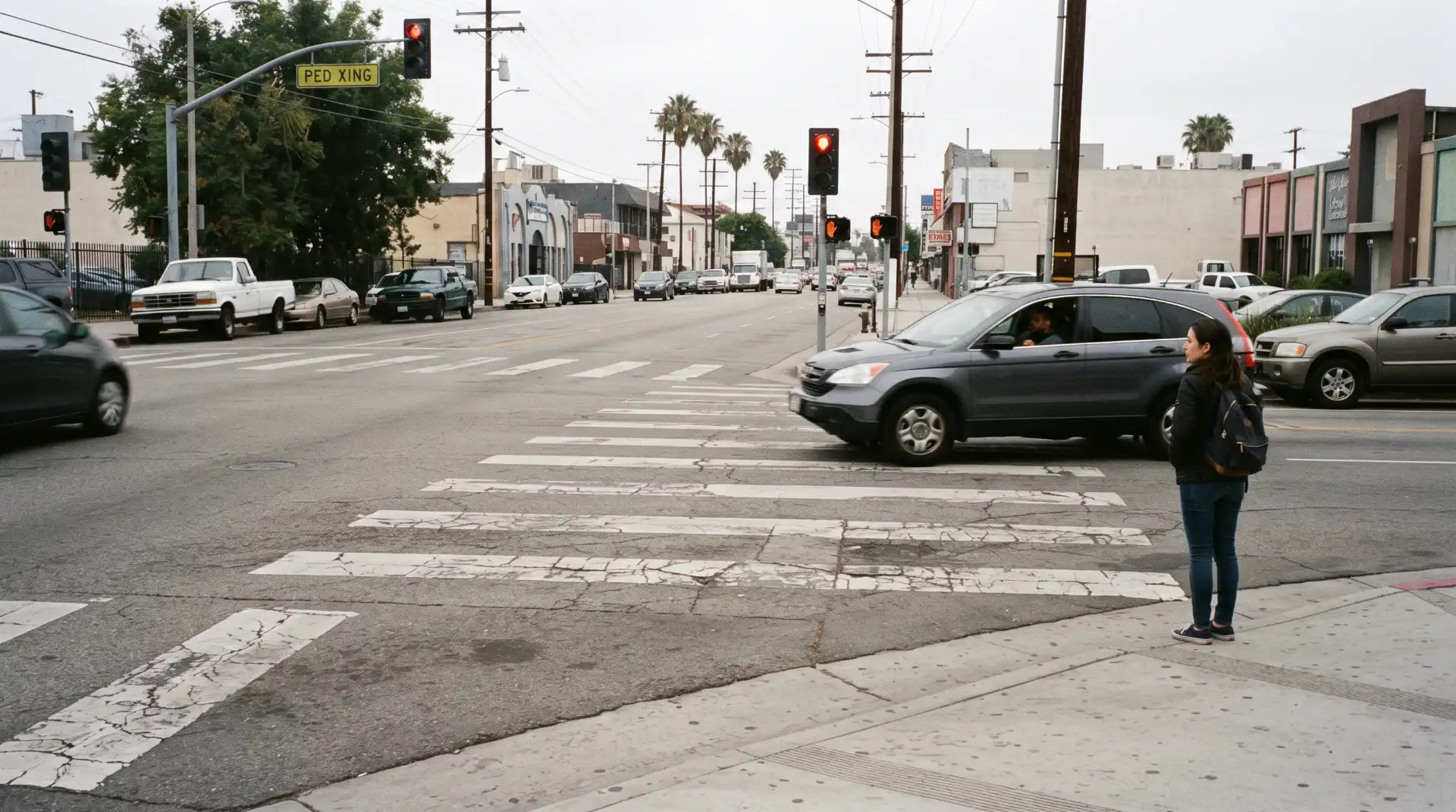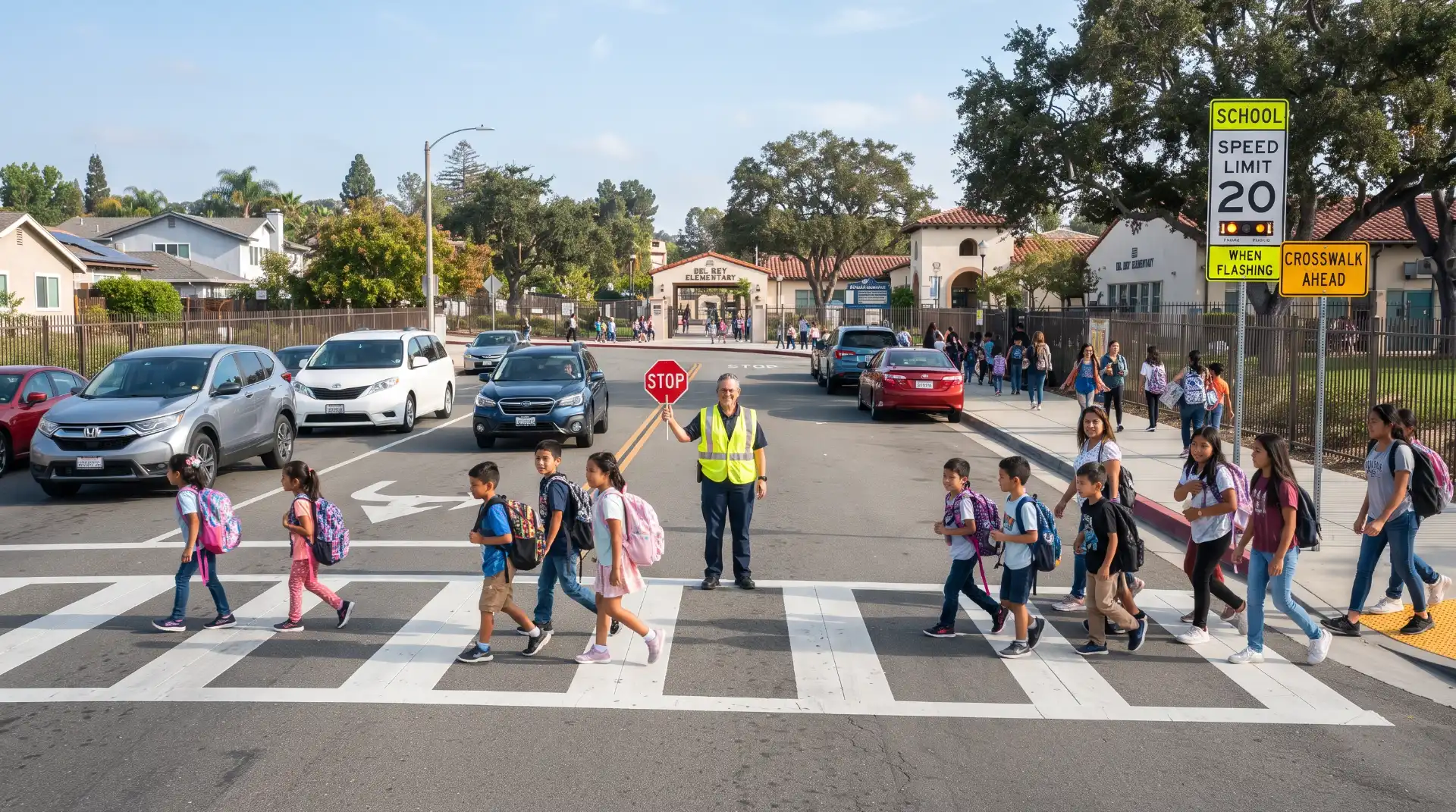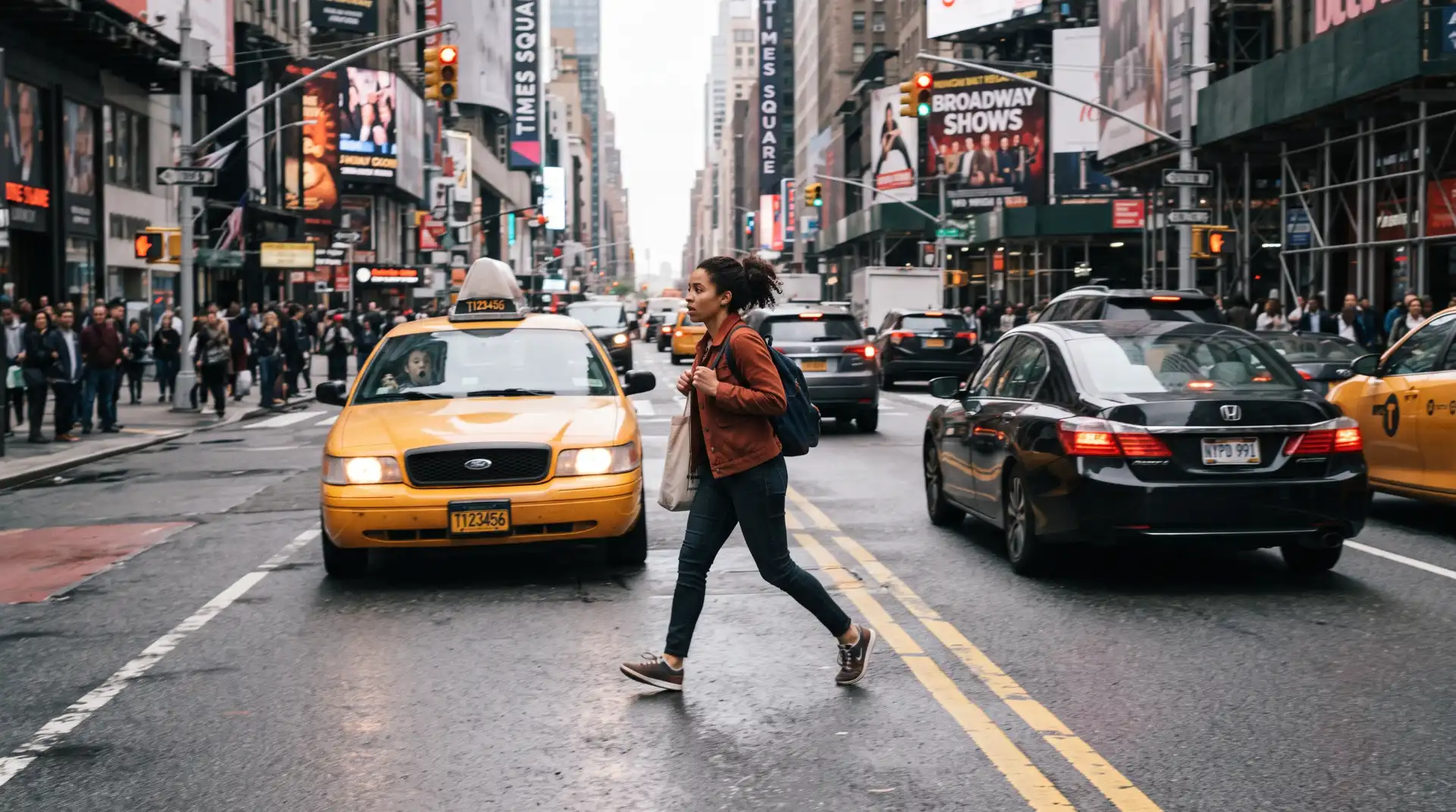
Crosswalks are intended to create predictable places for people to move across roads while giving drivers a clear indication that pedestrians may be present. Yet simply painting lines across a roadway does not necessarily make a crossing safe. The location, visibility, lighting, traffic speed, number of lanes, intersection geometry, signal timing, curb design, and surrounding environment can all influence whether a crosswalk adequately protects people on foot.
In California, this becomes more than a transportation-design issue when a pedestrian is seriously injured because of an allegedly dangerous roadway condition. A collision may initially appear to be a straightforward dispute between a pedestrian and a driver. However, the circumstances can sometimes raise another question: Did the design, construction, maintenance, or operation of the public roadway contribute to the accident?
That question can become particularly important when a crosswalk is positioned where drivers cannot easily see pedestrians, when markings have deteriorated, when a crossing is unusually long, when lighting is inadequate, or when roadway features create confusing movements for pedestrians and motorists.
California law allows certain claims involving dangerous conditions of public property, but establishing liability against a city or other public entity is considerably more complicated than proving that a private driver acted negligently. Government entities can have specific statutory defenses, procedural requirements, and immunities that may affect a claim.
California’s current traffic-control framework also emphasizes engineering considerations surrounding pedestrian crossings. Caltrans issued the California Manual on Uniform Traffic Control Devices (CA MUTCD) 2026, effective January 18, 2026, establishing updated standards and specifications for official traffic-control devices throughout the state.
Understanding how roadway design, pedestrian safety, and California public-entity liability intersect can help injured pedestrians and their families understand what evidence may matter after a serious crosswalk accident.
What Makes a Crosswalk Poorly Designed?
A poorly designed crosswalk is not necessarily one that looks old or unattractive. The more important issue is whether the crossing creates an unreasonable safety risk under the circumstances.
Crosswalk design is influenced by factors such as traffic volume, vehicle speeds, roadway width, pedestrian activity, sight distance, lighting, nearby intersections, transit stops, surrounding land uses, and the expected movement of pedestrians and vehicles.
Caltrans guidance specifically recognizes that engineering decisions concerning crosswalks can involve the number of lanes, presence or absence of a median, distance from nearby signals, pedestrian volumes, vehicle traffic, posted speed limits, roadway geometry, sight distance, street lighting, and other factors.
This means that a crosswalk cannot always be evaluated simply by asking whether paint exists on the pavement.
For example, imagine a four-lane roadway where a marked crosswalk is placed between two major intersections. The crossing may require pedestrians to travel a substantial distance across moving traffic. If there is no pedestrian refuge area, visibility is poor, vehicles routinely travel at high speeds, and parked cars block the driver’s view, the overall crossing environment may deserve closer examination after a collision.
Another example could involve a crosswalk located immediately next to a driveway or intersection where turning vehicles frequently enter the pedestrian path. Even though the crossing is technically marked, the combination of vehicle movements and pedestrian activity may create additional risks.
Poor visibility can be especially significant. A pedestrian may be legally present in a crosswalk while a driver approaching from a particular angle has limited ability to see that person until the vehicle is already close to the crossing.
The issue is therefore not simply whether a crosswalk exists. Investigators may need to determine whether its design and surrounding conditions were reasonably safe for the people expected to use it.
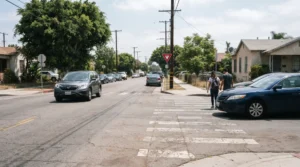
California Crosswalk Rules and Driver Responsibilities
California law generally provides important protections for pedestrians crossing within marked and certain unmarked crosswalks. California Vehicle Code Section 21950 addresses pedestrian right-of-way and requires drivers to yield to pedestrians crossing within a marked crosswalk or an unmarked crosswalk at an intersection.
The statute also requires drivers approaching pedestrians in a crosswalk to exercise due care and reduce speed or take other appropriate action when necessary for pedestrian safety.
At the same time, California law does not make pedestrian right-of-way unlimited. Pedestrians are not permitted to suddenly leave a curb or place of safety and move into the path of a vehicle that is so close that it creates an immediate hazard.
These rules demonstrate why pedestrian accident investigations cannot always be reduced to a simple statement that either the driver or pedestrian had the right-of-way.
A driver may be responsible for failing to yield, speeding, driving while distracted, or failing to maintain a proper lookout. A pedestrian can also potentially contribute to an accident through unsafe conduct. California’s comparative negligence system allows responsibility to be allocated according to the evidence.
For a broader explanation of California’s pedestrian rules, your existing article Understanding California Pedestrian Laws: What Every Pedestrian Should Know can serve as a useful internal resource.
The important distinction for a poorly designed crosswalk case is that the driver’s conduct may be only one part of the investigation. If roadway conditions also contributed to the crash, investigators may need to examine whether another responsible party or public entity played a role.
When Can a California City Potentially Be Liable?
California public entities are not automatically responsible whenever someone is injured on a city street.
Government Code Section 835 establishes circumstances under which a public entity may be liable for injuries caused by a dangerous condition of its property. California courts describe the basic framework as requiring a dangerous condition, a reasonably foreseeable risk of the type of injury that occurred, and, for certain claims based on failure to protect against an existing condition, actual or constructive notice sufficient to allow preventive action.
This is important because an injured pedestrian generally needs more than evidence showing that an accident happened at a crosswalk.
The claim may involve questions such as whether the public property was dangerous, whether that condition created a foreseeable risk of the type of injury suffered, whether the public entity created the condition or knew or should have known about it, and whether the condition was a substantial factor in causing the accident.
Consider a hypothetical intersection where a city has received repeated complaints about poor visibility at a crosswalk. Several previous incidents have reportedly occurred at the same location. The crosswalk is positioned immediately beyond a curve, vehicles regularly approach at relatively high speeds, and parked vehicles obstruct the pedestrian’s visibility.
If a pedestrian is later struck at that location, the evidence concerning prior complaints, roadway conditions, engineering evaluations, traffic studies, and previous incidents could become relevant.
That does not automatically establish government liability. Instead, it provides information that may help determine whether the legal requirements for a dangerous-condition claim can be satisfied.
The Difference Between a Dangerous Crosswalk and a Dangerous Driver
One of the most important concepts in these cases is the distinction between driver negligence and roadway conditions.
Suppose a pedestrian is walking through a marked crosswalk when a driver fails to yield and strikes the pedestrian. The driver’s conduct may provide the primary basis for a claim.
Now consider a different situation. A driver approaches an intersection where the crosswalk is difficult to see because the markings are severely faded, street lighting is inadequate, and roadway geometry prevents drivers from seeing pedestrians until they are very close. The driver fails to stop and strikes a pedestrian.
The driver may still have legal responsibility. However, the condition of the public roadway may also warrant investigation.
In some cases, more than one factor contributes to the collision. A driver can be negligent while a dangerous roadway condition also contributes to the accident. California’s legal system provides mechanisms for allocating responsibility among parties when supported by the evidence.
This is one reason a pedestrian accident investigation should not stop with the vehicle and driver.
The physical intersection itself can contain important evidence.
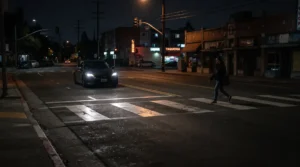
Common Crosswalk Design Problems That May Matter
Certain roadway characteristics can become particularly important when investigating a pedestrian accident.
Faded or Difficult-to-See Crosswalk Markings
Crosswalk markings communicate to drivers that pedestrians may be using a particular portion of the roadway. When markings become severely faded, their visibility can decrease.
However, faded paint alone does not automatically establish that a city is legally liable for an accident. The investigation may need to determine the condition of the markings before the collision, whether maintenance records exist, whether complaints were made, and whether other traffic-control devices provided adequate warning.
California’s current CA MUTCD includes dedicated provisions covering crosswalk markings and pedestrian-control features.
Poor Sight Distance
A pedestrian crossing may be difficult to navigate when buildings, landscaping, signs, parked vehicles, roadway curves, hills, or other objects prevent drivers from seeing pedestrians in time.
Sight distance is specifically identified by Caltrans as one of the considerations relevant to evaluating crosswalk locations.
A post-accident investigation may therefore involve measurements and photographs showing what a driver could see while approaching the crosswalk.
Excessive Crossing Distance
A very wide roadway can expose a pedestrian to moving traffic for a longer period of time.
Crossing distance becomes particularly important where there are multiple travel lanes, turning lanes, medians, or complex intersection movements.
A pedestrian may also be exposed to additional risks when a driver in one lane stops but a vehicle in another lane continues through the crossing.
Poor Lighting
Nighttime pedestrian crashes can become particularly difficult to reconstruct when lighting is inadequate.
Investigators may examine whether streetlights were functioning, where the light sources were located, whether the pedestrian was visible from approaching vehicles, and whether other objects created shadows.
Lighting is recognized by Caltrans as one of the considerations involved in pedestrian crossing decisions and is also identified among broader roadway safety resources.
Confusing Traffic Movements
A crosswalk can become more complicated when vehicles are simultaneously turning, changing lanes, entering driveways, or moving through multiple lanes.
Drivers may focus on other vehicles and fail to notice pedestrians. Pedestrians may also have difficulty determining which vehicle has stopped for them and which vehicle may continue moving.
Intersection geometry can therefore influence both driver behavior and pedestrian exposure.
Crosswalks Near Bus Stops
The location of a crosswalk relative to public transportation stops can also matter.
Caltrans guidance recommends considering crosswalks or enhanced crosswalks near transit stops where appropriate and notes that placement behind or upstream of a bus stop can help reduce conflicts between pedestrians and transit buses.
This illustrates why crosswalk placement is an engineering issue rather than merely a matter of painting lines on a roadway.
Could a City Be Liable for a Crosswalk That Was Designed Years Ago?
Potentially, but the age of a roadway does not by itself establish liability.
A city may argue that the roadway was designed and approved according to applicable standards at the time. In some cases, a public entity may also raise design immunity under California Government Code Section 830.6.
California courts explain that design immunity can protect a public entity from certain claims involving an approved plan or design when the statutory requirements are satisfied. The California Supreme Court has described three important elements: a causal relationship between the plan or design and the accident, discretionary approval of the plan or design before construction, and substantial evidence supporting the reasonableness of the plan or design.
That means a claim involving an allegedly defective crosswalk can become technically complex.
The question may not simply be whether today’s standards would produce a different intersection. Investigators may need to examine what standards applied when the roadway was designed, who approved the design, what evidence supported the original decision, and whether circumstances later changed.
This is one reason older roadway projects require careful historical investigation.
What Is Design Immunity?
Design immunity is an important concept in California public-property cases because it can limit government liability for certain approved public improvements.
Suppose a city designed an intersection decades ago according to an approved engineering plan. A pedestrian later argues that the geometry of the intersection creates an unreasonable risk because vehicles can approach the crosswalk at relatively high speeds.
The city may assert that the roadway’s design was approved through the required discretionary process and that substantial evidence supported the design when it was approved.
That does not mean every public roadway automatically receives immunity.
California’s Judicial Council civil jury instructions explain that design immunity requires the public entity to establish specific elements, including the causal relationship between the design and accident, discretionary approval before construction, and substantial evidence supporting the reasonableness of the plan or design.
The existence and scope of such a defense can therefore become a major issue in litigation involving roadway design.
What If the Crosswalk Was Safe Originally but Became Dangerous Later?
This is another important issue.
Roadways change over time. Traffic volumes can increase, surrounding businesses can open, pedestrian activity can grow, nearby development can change traffic patterns, and vehicles can begin traveling through an area differently than they did when the roadway was originally designed.
Physical conditions can also deteriorate.
Crosswalk markings may fade. Lighting may stop functioning. Signs can become obstructed. Vegetation can interfere with sightlines. Roadway configurations can change because of construction or nearby development.
California case law recognizes that design immunity does not necessarily resolve every issue that can arise when physical circumstances change. The California Supreme Court’s discussion of design immunity has addressed circumstances in which changed conditions may affect the continued applicability of the defense.
This makes maintenance and post-construction evidence especially important.
A city may have records showing inspections, maintenance requests, traffic studies, citizen complaints, roadway modifications, or safety evaluations.
Those records can help establish what the public entity knew about the location and when it knew it.
Why Previous Complaints Can Matter
Previous complaints do not automatically prove that a city was negligent, but they can become important evidence in a dangerous-condition investigation.
Imagine that residents repeatedly complained that drivers could not see pedestrians at a particular crosswalk. If those complaints were submitted months or years before a collision, they could potentially help establish what the city knew or should have known about the condition.
Other potentially relevant evidence can include police collision reports, traffic studies, transportation department records, engineering evaluations, maintenance logs, work orders, photographs, correspondence, public meeting records, and requests for traffic-control improvements.
A serious investigation may therefore require more than interviewing the injured pedestrian and the driver.
It may involve reconstructing the history of the intersection.
What Evidence Can Help Establish a Poorly Designed Crosswalk?
Evidence is particularly important when the alleged cause of an accident involves roadway design.
Photographs and video taken immediately after the accident can document the condition of the crosswalk, traffic signs, lighting, road surface, parked vehicles, lane configuration, traffic signals, and surrounding structures.
Measurements can also become important. The distance between the crosswalk and an intersection, roadway width, lane configuration, sight distance, lighting locations, and vehicle approach paths may all help experts understand the collision.
Witness testimony can provide information about what drivers and pedestrians could see.
Surveillance video can be especially valuable because it may show the sequence of events rather than merely the aftermath.
Traffic-camera footage, nearby business surveillance, residential security cameras, dashcam recordings, and cellphone video may all provide useful evidence.
Your existing article, How Pedestrian Accidents Are Investigated in California: The Legal Process Explained, provides a useful internal resource for readers who want a broader explanation of the investigation process.
Engineering Evidence May Be Important
Some poorly designed crosswalk cases require more technical analysis than an ordinary driver-negligence claim.
A transportation engineer or accident reconstruction professional may examine the roadway configuration, vehicle approach speeds, pedestrian visibility, stopping distances, signal timing, lighting, crosswalk placement, and other physical characteristics.
The goal is not simply to argue that a roadway “looks dangerous.”
A meaningful analysis attempts to connect the physical condition to the accident and determine whether the alleged condition created the type of risk that occurred.
Caltrans’ current traffic-calming resources identify several tools that can be used to improve pedestrian safety, including high-visibility crosswalk markings, improved lighting, advance stop or yield markings, parking restrictions, curb extensions, raised crosswalks, rectangular rapid flashing beacons, and pedestrian hybrid beacons.
The availability of these safety treatments does not mean a city must install every treatment at every crossing. Instead, these resources demonstrate that pedestrian crossing design involves multiple engineering considerations.
Could the City, Driver, and Another Party All Be Involved?
Yes, depending on the facts.
A pedestrian collision can involve several potentially relevant parties.
A negligent driver may have failed to yield. A public entity may be accused of maintaining a dangerous roadway condition. A construction contractor may have created a temporary obstruction. A private property owner may have allowed vegetation or another object to interfere with visibility. A transit operator may have contributed to visibility issues.
The presence of multiple potential parties makes accident investigation especially important.
California’s comparative fault rules can affect how responsibility is allocated. A pedestrian’s conduct can also be considered if evidence shows that the pedestrian contributed to the collision.
For example, suppose a pedestrian crosses through a marked crosswalk while a driver is approaching too quickly. At the same time, an illegally parked vehicle blocks the driver’s view of the crosswalk. The roadway configuration may also place the crosswalk in a location where visibility is limited.
Determining responsibility could require examining the driver’s conduct, the parking condition, roadway design, and the pedestrian’s actions together.
What Happens When a Public Entity Is Involved?
A claim involving a city, county, state agency, or other public entity has additional procedural considerations.
California’s Government Claims Act contains specific rules concerning claims against public entities. For injury or death claims covered by Government Code Section 911.2, the claim generally must be presented within six months after the cause of action accrues.
This deadline is significantly different from the ordinary timeline that may apply to claims against private parties.
That distinction can become extremely important after a pedestrian accident involving an allegedly dangerous public crosswalk.
An injured person should not assume that filing a normal insurance claim with the driver or vehicle insurer satisfies the requirements for pursuing a claim against a city or county.
Different defendants can have different procedures.
Because missing a government-claim deadline can seriously affect legal rights, anyone considering a claim against a California public entity should obtain case-specific legal advice promptly.
What About a Crosswalk on State Property?
Not every California crosswalk is controlled by a city.
Depending on the location, responsibility may involve a city, county, state agency, transit authority, school district, or another public entity.
A pedestrian accident on a state highway, for example, may involve different governmental responsibilities than a collision on a city street.
Determining ownership and control of the roadway is therefore an important early step.
Maps, roadway records, signs, maintenance responsibilities, transportation agency records, and property information can help identify which entity controls the relevant portion of the roadway.
The injured pedestrian does not necessarily need to determine every aspect of governmental responsibility personally, but identifying the correct entity quickly can be important when evidence and claim deadlines are involved.
What Should Pedestrians Do After a Crosswalk Accident?
The first priority after a pedestrian accident is safety and medical treatment.
Serious pedestrian injuries can include fractures, traumatic brain injuries, spinal injuries, internal injuries, soft-tissue damage, and other conditions that may not be immediately obvious.
After receiving appropriate medical care, preserving information about the accident can become important.
If physically possible, photographs should document the crosswalk, roadway, vehicle positions, traffic signals, signs, lighting, surrounding buildings, parked vehicles, lane markings, and any condition that may have affected visibility.
Witness contact information should also be preserved.
If surveillance cameras are visible near the intersection, identifying those locations promptly can be useful because video may not be retained indefinitely.
It can also be important to preserve photographs of the intersection from the same approach direction that the driver was using. A photograph taken from the sidewalk may not accurately demonstrate what a driver could see while approaching the crosswalk.
Your existing guide, Steps to Take After a Pedestrian Accident in California, can provide readers with additional information about documenting an accident and dealing with the immediate aftermath.
Do Not Assume the Crosswalk Makes the Case Automatic
One of the most important points for readers to understand is that a marked crosswalk does not automatically make a city responsible for every accident that occurs there.
Likewise, a dangerous-looking intersection does not automatically establish government liability.
A successful claim involving a public roadway generally requires evidence addressing the applicable legal elements.
The investigation may need to establish the condition of the property, the nature of the risk, the relationship between that condition and the accident, the public entity’s role or knowledge, and whether a statutory defense applies.
These questions are highly fact-specific.
For example, two intersections can appear almost identical but produce very different legal outcomes because one city had repeated notice of a dangerous condition while the other had no reason to know about the alleged hazard.
Likewise, one roadway may have been constructed under an approved design supported by substantial evidence while another location may have been modified without appropriate review.
The details matter.
How Insurance Issues Can Complicate a Crosswalk Claim
Pedestrian accident victims frequently deal with the driver’s automobile insurance company after a collision.
If the driver was negligent, the driver’s liability insurance may be an important source of compensation for covered damages.
However, a government-liability issue can create an entirely different layer of complexity.
An insurance adjuster representing the driver may focus primarily on whether the motorist was responsible. Meanwhile, a public entity may dispute whether the roadway was dangerous or whether the statutory requirements for government liability have been satisfied.
A victim may therefore be dealing with multiple legal theories at the same time.
Your existing article, What to Know About Insurance Coverage for Pedestrian Accidents in California, can be used as an internal resource for readers researching the insurance side of pedestrian injury claims.
The insurance process and a potential public-entity claim should not automatically be treated as the same thing.
Can a City Be Responsible for Inadequate Crosswalk Safety Improvements?
Potentially, but again, the circumstances matter.
Caltrans identifies a range of pedestrian safety treatments that can be considered depending on roadway conditions and engineering judgment. These include high-visibility crosswalks, improved lighting, curb extensions, raised crosswalks, pedestrian hybrid beacons, rectangular rapid flashing beacons, and pedestrian refuge islands.
A city is not necessarily legally required to install every possible safety treatment simply because one exists.
However, evidence concerning roadway studies, traffic patterns, previous collisions, public complaints, engineering evaluations, and known hazards may become relevant when determining whether an allegedly dangerous condition existed and whether the public entity had an appropriate opportunity to respond.
The legal question is therefore more complicated than asking whether the city could have built a safer intersection.
The relevant question is whether the evidence satisfies the legal standards governing liability for dangerous conditions of public property.
What Role Does the 2026 CA MUTCD Play?
The CA MUTCD 2026 is particularly relevant to transportation professionals and anyone researching current traffic-control standards.
Caltrans states that the 2026 edition became effective January 18, 2026, replacing the prior 2014 revision as California’s applicable manual for official traffic-control devices. The manual includes dedicated sections concerning signs, pavement markings, crosswalk markings, pedestrian signals, pedestrian hybrid beacons, accessible pedestrian signals, and other traffic-control features.
However, readers should be careful not to assume that a deviation from a particular guideline automatically creates civil liability.
Traffic-control standards are one piece of the overall analysis.
The relevant roadway may have been designed under earlier standards. Certain provisions may be recommendations rather than automatic legal duties. Engineering judgment may also be involved.
For a legal claim, an attorney or qualified expert may need to determine which standards applied at the relevant time and how those standards relate to the specific roadway condition.
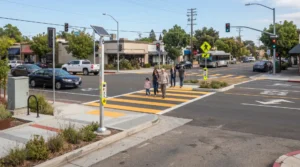
Can Better Crosswalk Design Help Prevent Future Pedestrian Accidents?
Improved design can play an important role in reducing pedestrian exposure to traffic.
Caltrans’ current safety resources identify multiple strategies for improving crossings. High-visibility markings can make crossing locations more noticeable. Curb extensions can shorten pedestrian crossing distances and improve visibility. Pedestrian refuge areas can allow people to cross a wide roadway in stages. Rectangular rapid flashing beacons can provide additional warnings to approaching drivers. Pedestrian hybrid beacons can provide stronger traffic control at certain crossings.
Lighting can also be important, particularly at locations with significant nighttime pedestrian activity.
The appropriate treatment depends on the roadway.
A treatment that works well on a neighborhood street may not be appropriate for a high-speed multilane arterial. Engineering studies can help determine which safety improvements fit the traffic environment.
This is why pedestrian safety involves both legal and transportation-engineering considerations.
What a Thorough Investigation May Examine
A serious investigation into a pedestrian accident at a potentially dangerous crosswalk can involve several categories of evidence.
Investigators may examine the physical intersection, roadway geometry, crosswalk placement, lane configuration, traffic signals, lighting, signs, pavement markings, vehicle speeds, pedestrian movement, visibility, weather conditions, and surrounding obstacles.
They may also investigate the history of the location.
Previous collisions, citizen complaints, traffic studies, maintenance requests, engineering reports, roadwork records, inspection documents, and communications involving the intersection may help establish whether the alleged dangerous condition was known before the accident.
The timing of those records can be particularly significant.
A complaint submitted after the accident may not establish what the city knew beforehand. A documented warning made years earlier may provide a very different type of evidence.
This is why preserving records and investigating the history of the intersection can be important.
Common Mistakes After an Accident Involving a Dangerous Crosswalk
One common mistake is assuming that the driver is automatically the only party who can be investigated.
Another is assuming that because the accident happened in a crosswalk, the city must automatically be liable.
Both assumptions can overlook important evidence.
Another problem is waiting too long to investigate the roadway. Physical conditions can change quickly. A faded crosswalk may be repainted. Construction may alter the intersection. Parked vehicles may move. Landscaping may be trimmed. Temporary signs may disappear.
Video recordings can also be overwritten.
For accidents involving public property, waiting can be especially problematic because government-claim deadlines can be substantially shorter than ordinary personal-injury deadlines. California Government Code Section 911.2 generally requires injury claims against public entities to be presented within six months after accrual.
Anyone who believes a dangerous public roadway contributed to a serious pedestrian accident should therefore consider obtaining legal advice promptly rather than waiting until the evidence or deadlines become difficult to address.
Frequently Asked Questions About Poorly Designed Crosswalks in California
Can I sue a California city if I was hit in a crosswalk?
Possibly, but being injured in a crosswalk does not automatically establish city liability. A claim against a public entity generally requires evidence satisfying the applicable California Government Claims Act requirements and establishing the elements of a legally recognized claim, such as a dangerous condition of public property.
What is a dangerous condition of public property?
In general terms, a dangerous condition involves a condition of public property that creates a reasonably foreseeable risk of the type of injury that occurred, subject to the specific requirements of California’s Government Claims Act. The exact legal analysis depends on the facts and applicable statutes.
Does a faded crosswalk prove that the city was negligent?
No. Faded markings may be relevant evidence, but they do not automatically establish negligence or public-entity liability. Investigators may need to determine how long the markings were in poor condition, whether the city knew or should have known about the problem, and whether the condition substantially contributed to the accident.
Can a city claim design immunity?
Yes, in appropriate circumstances. California Government Code Section 830.6 provides a design-immunity defense for qualifying public improvements when the statutory requirements are established. California courts have identified discretionary approval, substantial evidence supporting the reasonableness of the design, and a causal relationship between the design and accident as important elements of the defense.
What if the roadway became dangerous after it was built?
Changed physical conditions can be important. A roadway’s original design and the conditions that existed years later are not necessarily the same issue. Evidence concerning changes in traffic, roadway configuration, visibility, maintenance, and known hazards may become relevant.
How long do I have to make a claim against a California city?
For injury claims covered by Government Code Section 911.2, the general claim-presentation period is six months after the cause of action accrues. Other deadlines and procedures can apply depending on the circumstances, so anyone considering a claim against a public entity should seek legal advice promptly.
Can a driver and a city both be involved in the same pedestrian accident?
Potentially. If the evidence supports separate legal theories of responsibility, a pedestrian accident may involve both driver negligence and an alleged dangerous condition of public property. The specific facts determine whether claims against multiple parties are legally viable.
Why Crosswalk Design Matters After a Serious Pedestrian Accident
Crosswalks are supposed to make pedestrian movement more predictable and safer, but their effectiveness depends on much more than painted lines.
The surrounding roadway, traffic speeds, sight distance, lighting, signal timing, intersection geometry, lane configuration, pedestrian volumes, and nearby transportation facilities can all affect how safely pedestrians and vehicles interact.
When a pedestrian is seriously injured, those conditions may become important evidence.
California law provides a framework for holding public entities responsible for certain dangerous conditions of public property, but government-liability cases involve specialized rules that do not apply to ordinary claims against private drivers. Design immunity, notice requirements, government-claim deadlines, and other legal issues can significantly affect whether a claim can proceed.
For that reason, an accident at a poorly designed crosswalk should be investigated based on the actual evidence rather than assumptions.
The most useful questions may include: What did the intersection look like when the collision occurred? What could the driver see? What could the pedestrian see? How fast was traffic moving? Was the crosswalk clearly marked? Was lighting adequate? Were signs and signals functioning? Had the city received previous complaints? Had other crashes occurred there? Were roadway improvements previously recommended? Had the physical conditions changed since the original design?
Answers to those questions can help clarify whether the collision was simply the result of individual driver conduct or whether roadway conditions may also have contributed.
For injured pedestrians and their families, understanding that distinction can be an important part of determining what evidence should be preserved and what legal options may need to be explored.